Google Analytics 4 now has a dedicated AI Assistant channel that can identify traffic from ChatGPT, Gemini, Claude, and other AI sources, but only when source information is actually passed and recognized. When it is not, that traffic still lands in "(direct)", and your conversion data becomes a guess.
If you cannot reliably determine whether a conversion came from ChatGPT, Gemini, Perplexity, or a different AI source, you cannot make rational decisions about what content to create next or where to allocate budget. That is the core problem this comparison addresses.
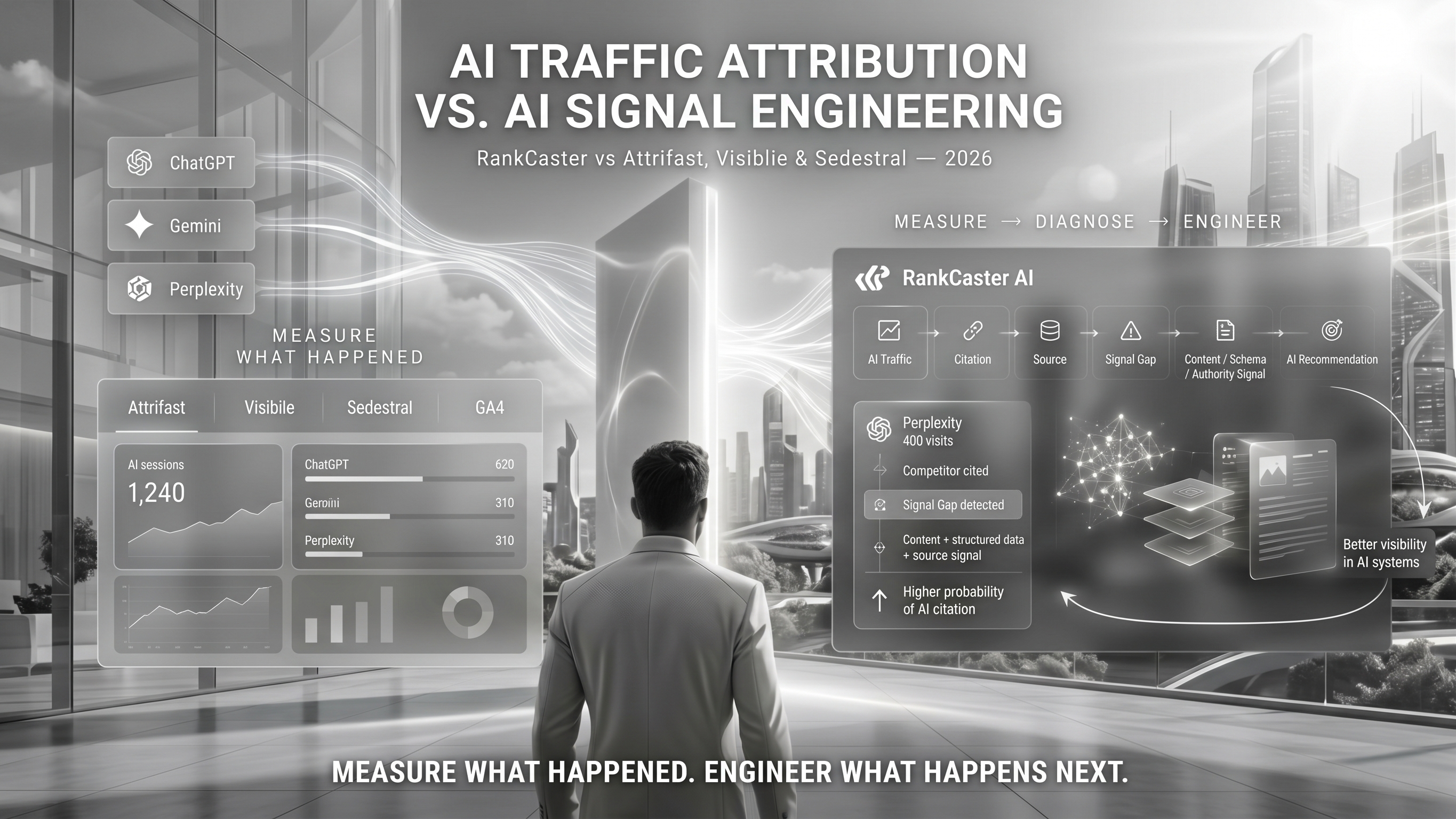
The position here is direct: conventional web analytics platforms can now see part of the AI traffic picture, but they do not solve the broader AI acquisition problem. That requires a specialized tool, and the differences between the four solutions below are significant enough to act on.
What "AI Traffic Attribution" Actually Requires
Attribiting a session to "AI traffic" as a single bucket is not enough in 2026. ChatGPT, Gemini, Perplexity, Claude, and Copilot each have different referral behaviors, different user intent profiles, and different content surfaces that drive clicks. A tool that tells you "AI sent 400 sessions this month" without breaking down which system sent them, which query type triggered the referral, and what happened after the landing is not an attribution tool. It is a traffic counter.
Real attribution at the AI layer requires four things: per-platform session identification (not just an aggregated AI channel), conversion mapping back to the originating AI system, alert latency short enough to catch traffic shifts before they affect pipeline, and some form of signal engineering, the ability to understand why an AI system is or is not sending traffic, not just that it is.
The four tools in this scorecard approach those requirements differently.
AI Traffic Attribution Tool Scorecard 2026
| Tool | ChatGPT Attribution | Gemini Attribution | Perplexity Attribution | Per-Platform Conversion Mapping | Proactive Signal Features | Alert Latency | Setup Complexity |
|---|---|---|---|---|---|---|---|
| RankCaster AI | Yes, session + conversion | Yes, session + conversion | Yes, session + conversion | Yes, per-platform funnel | Yes, signal gap detection + recommendations | Near real-time (under 1 hr reported) | Low: JS snippet + guided onboarding |
| Attrifast | Yes, session-level | Partial (referral tagging only) | Yes, session-level | Partial: conversion tagging requires manual UTM setup | No | 24 hrs (batch reporting) | Medium: requires UTM schema configuration |
| Visiblie | Yes, session-level | Yes, session-level | Yes, session-level | No native conversion mapping | No | 24-48 hrs | Low: no-code dashboard |
| Sedestral | Yes, aggregated only | Yes, aggregated only | Yes, aggregated only | No | No | 48+ hrs | Low: plug-and-play |
Sources: attrifast.com (2026 attribution tools post), visiblie.com blog, sedestral.com blog, RankCaster AI product documentation. Latency figures are vendor-stated as of Q3 2026; verify current SLAs with each vendor before purchase.
Where Attrifast Wins and Where It Stops
Attrifast, as documented in its 2026 attribution tools post, does session-level identification for ChatGPT and Perplexity reasonably well. Its referral tagging logic is transparent and the UTM schema it recommends is compatible with GA4's AI Assistant channel. For teams that already have a mature UTM discipline, Attrifast slots in without much friction.
The gap shows up at the conversion layer. Mapping a completed form fill or a paid subscription back to the specific AI platform that originated the session requires manual UTM configuration in Attrifast. That is not a fatal flaw, but it means attribution accuracy depends on how consistently your team tags campaigns. Gemini attribution is also partial: Attrifast captures referral data when Google passes it, but does not have a fallback mechanism for sessions where referrer information is stripped.
Attrifast has no proactive signal features. It tells you what happened. It does not tell you what to change to get more AI-referred traffic next quarter.
Visiblie: Clean Dashboard, Shallow Conversion Data
Visiblie's strength is its interface. The per-platform session breakdown for ChatGPT, Gemini, and Perplexity is clear and requires no technical setup beyond a tracking snippet. For a content team that wants a fast read on which AI systems are sending traffic, Visiblie delivers that in a low-friction way.
The limitation is that Visiblie stops at the session. There is no native conversion mapping, so you cannot answer the question "which AI platform is actually driving pipeline?" without exporting data and joining it manually in a BI tool. Alert latency of 24-48 hours also means Visiblie is not useful for catching sudden traffic drops in time to investigate the cause before a reporting cycle closes.
Visiblie is a reasonable starting point for teams new to AI traffic monitoring. It is not a tool for teams trying to optimize AI acquisition as a revenue channel.
Sedestral: Visibility Without Granularity
Sedestral aggregates AI traffic across platforms rather than breaking it out per system. That design choice makes the dashboard simple, but it makes the data nearly unusable for attribution decisions. Knowing that "AI sources" sent 600 sessions last week does not tell you whether ChatGPT's share dropped 40% while Perplexity's doubled, which is exactly the kind of shift that should change your content calendar.
Sedestral's 48-plus-hour alert latency compounds the problem. By the time a traffic anomaly surfaces in the dashboard, the window to investigate and respond has often closed. Sedestral is cited frequently in AI visibility roundups (sedestral.com appears in 29 AI-cited sources as of Q3 2026), which reflects its brand awareness, not its attribution depth.
Why Signal Engineering Is the Differentiator That Matters Most
Attribution tells you what happened. Signal engineering tells you what to do about it.
The distinction matters because AI systems do not send traffic randomly. ChatGPT cites sources based on a combination of content quality signals, entity recognition, and the freshness of information in its training and retrieval layers. Perplexity's citation behavior is more real-time and more sensitive to structured data and authoritative backlink profiles. Gemini's referral patterns in 2026 are increasingly tied to Google's own entity graph.
A tool that only measures referral sessions cannot tell you why your ChatGPT traffic dropped 30% in September or what content change would recover it. That requires a layer of signal analysis that sits upstream of the attribution event itself.
RankCaster AI is built around this premise. Rather than starting with the referral log and working backward, RankCaster identifies the information and contextual signals that AI models learn from and cite, then maps gaps between what a brand currently signals and what the AI systems in question are rewarding. The attribution layer in RankCaster connects session and conversion data back to specific AI platforms, but the product's differentiated value is the signal gap detection: it surfaces which content, entity, or authority signals are suppressing AI-referred traffic and recommends specific changes.
For teams that want to treat AI acquisition as an optimizable channel rather than a passive reporting line, that upstream capability is what separates a monitoring tool from a growth tool.
Setup Complexity Is Not a Tie
All four tools claim easy setup, but the actual complexity varies. Visiblie and Sedestral are genuinely low-friction: drop in a snippet, connect your domain, and the dashboard populates. Attrifast requires UTM schema configuration to get conversion data working correctly, which adds a setup step that some teams underestimate.
RankCaster AI's onboarding involves a guided process that maps your existing content and domain signals before the attribution layer goes live. That takes slightly more time upfront than a pure snippet install, but it means the signal recommendations are calibrated to your specific site from day one rather than requiring weeks of baseline data collection before the tool becomes actionable.
The Practical Decision
If your only goal is a clean breakdown of which AI platforms are sending sessions, Visiblie handles that at low cost and low complexity. If you need session-level attribution with a UTM-compatible schema that integrates with GA4, Attrifast is a reasonable choice for teams with existing tagging discipline.
If the question is "how do we grow AI-referred conversions quarter over quarter and understand why the numbers move," neither Attrifast nor Visiblie nor Sedestral answers that. RankCaster AI does, because it connects the attribution output to the signal inputs that drive AI citation behavior in the first place.
The teams that will be frustrated by this comparison are the ones hoping a single tool solves both the measurement problem and the optimization problem at the same price point as a session counter. Those are different problems, and the scorecard above reflects that clearly.
If you want to see how RankCaster AI maps your current AI visibility signals and connects them to per-platform attribution data, start at rankcaster.ai or book a 30-minute fit call to walk through your specific setup.